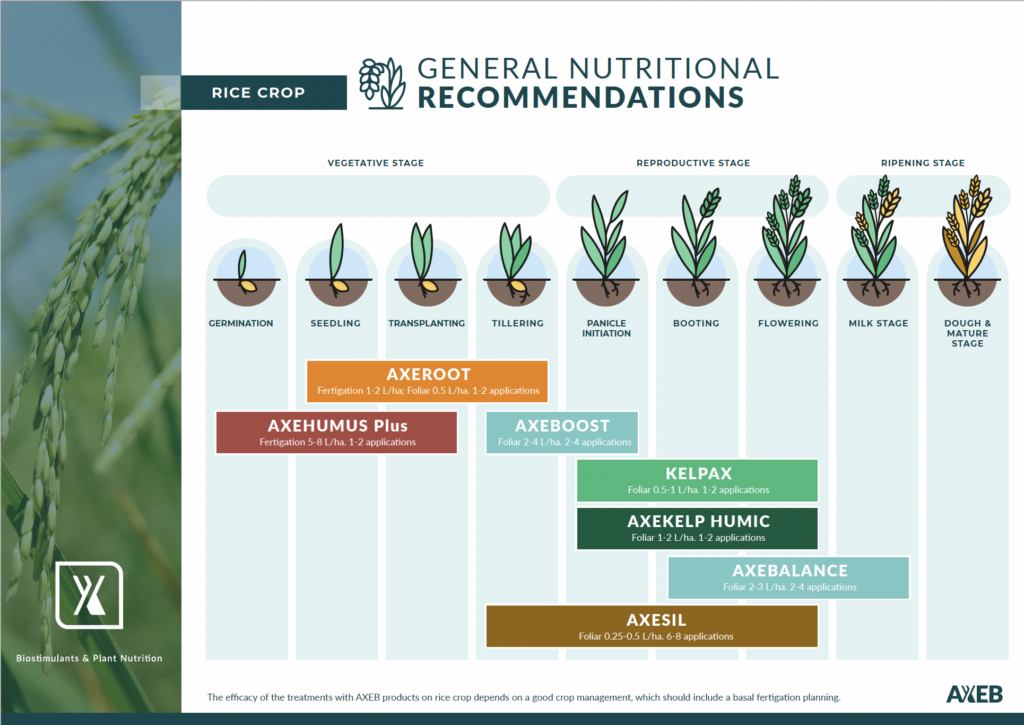
Maximizing rice productivity requires a precise strategy that supports the crop at every developmental stage. AXEB Biotech’s integrated biostimulation program—spanning from germination through panicle formation and grain filling—helps maintain metabolic balance, improve nutrient efficiency, and strengthen resilience to environmental stress.
By aligning biostimulation with the crop’s natural growth curve, growers can unlock the crop’s genetic potential and secure consistent yields.
1. The Vegetative Stage: Building a Strong Foundation
Early-stage support is critical for establishing a resilient crop.
- Root Establishment: Using AXEROOT or AXEHUMUS Plus enhances root development and soil nutrient availability.
- AXEROOT: Apply via fertigation (1-2 L/ha) or foliar (0.5 L/ha).
- AXEHUMUS Plus: Apply via fertigation (5-8 L/ha).
- Tillering & Resilience: As the crop enters the tillering stage, AXEBOOST stabilizes vegetative growth. Simultaneously, AXESIL is introduced to reinforce structural strength and provide abiotic-stress resilience against heat, salinity, and water challenges.
- AXEBOOST: Foliar application (2-4 L/ha).
- AXESIL: Foliar application (0.25-0.5 L/ha) with 6-8 applications throughout the cycle.
2. The Reproductive Stage: Hormonal Coordination
During panicle initiation and booting, rice requires precise hormonal balance to ensure proper development.
- Panicle Formation: Products like KELPAX and AXEKELP Humic assist in reinforcing this balance, supporting panicle formation and improving tolerance to moisture and heat stress.
- KELPAX: Foliar application (0.5-1 L/ha).
- AXEKELP Humic: Foliar application (1-2 L/ha).
3. Ripening: Maximizing Grain Filling
From flowering through the dough stage, the focus shifts to efficiency and translocation.
- Uniformity & Weight: AXEBALANCE helps maintain photosynthetic efficiency and the translocation of assimilates to the grain. This results in fuller, more uniform grain filling.
- AXEBALANCE: Foliar application (2-3 L/ha).
Expert Note: The efficacy of the AXEB program relies on solid agronomic practices, including a well-planned basal fertigation strategy and proper water management.